
Bengal health & hereditary diseases

PK-Def, PRA-b and HCM in Bengals – explained simply

Which hereditary diseases occur in Bengal cats, how are they passed on – and how can you recognise a breeder who takes health seriously? Here are the answers, clearly explained and without jargon.

The key points at a glance

  • Bengals are generally robust cats – but as in every breed, there are some known hereditary diseases.
  • Reliable DNA tests exist for PK-Def (inherited anaemia) and PRA-b (inherited blindness). Responsible breeders test all breeding cats.
  • For HCM (thickening of the heart muscle) there is no DNA test for Bengals yet – only regular echocardiography helps.
  • A carrier is healthy itself. Kittens can only be affected if both parents pass on the gene.
  • Ask to see the results of both parents – ideally as laboratory reports.

Are Bengals healthy cats?

Yes – Bengals are considered robust, athletic cats and often live 12 to 16 years. As in every breed, however, there are some hereditary conditions that can occur in Bengal lines. The good news: tests exist today for the most important ones. Responsible breeders use them to breed healthy kittens – and buyers can ask about them specifically.

How are hereditary diseases passed on? Explained simply

Every cat has two copies of each gene – one from the mother, one from the father. The hereditary diseases PK-Def and PRA-b are inherited recessively. This means a cat only becomes ill if both copies are altered.

That gives three possibilities:

  • Clear (N/N): two healthy copies. The cat is healthy and cannot pass the disease on.
  • Carrier (N/affected): one healthy and one altered copy. The cat is completely healthy itself but can pass the altered copy on to its kittens.
  • Affected: two altered copies. The cat can become ill.

What does this mean for the kittens?

  • Clear × clear: all kittens are clear.
  • Carrier × clear: no kitten becomes ill – statistically about half are healthy carriers.
  • Carrier × carrier: statistically one kitten in four is affected. Responsible breeders avoid exactly this pairing by testing both parents.

PK-Def – inherited anaemia

In pyruvate kinase deficiency, the red blood cells lack an important enzyme for their energy supply. As a result they break down faster – leading to anaemia, which often comes in episodes. Possible signs include tiredness, weakness, weight loss, yellowing of the mucous membranes or a swollen belly. When and how severely the disease shows varies greatly – some cats have hardly any symptoms.

Test: DNA test via a simple cheek swab. It reliably shows whether a cat is clear, a carrier or affected.

PRA-b – inherited blindness

In progressive retinal atrophy of the Bengal, the light-sensitive cells of the retina gradually die off. This begins in the first weeks of life; by about two years of age, vision is usually severely impaired. The disease is not painful, but it cannot be cured. The responsible gene variant is typical of the Bengal breed.

Test: DNA test via cheek swab. Carriers can only be identified this way – you can't see anything from the outside.

HCM – thickening of the heart muscle

Hypertrophic cardiomyopathy is the most common heart disease in cats overall – including non-pedigree domestic cats. It also occurs in Bengal lines. The heart muscle thickens and the heart works less well. Many cats show no signs for a long time; in advanced stages, heart failure, blood clots or sudden death can occur.

Important: There is currently no DNA test for HCM in Bengals. The DNA tests that exist for Maine Coons or Ragdolls tell you nothing about Bengals. The only reliable examination is echocardiography (heart ultrasound) by an experienced vet or cardiologist. Because HCM can also develop later in life, breeding cats should be examined regularly – usually once a year. A normal result is always a snapshot.

Other health topics

  • PKD (kidney cysts): best known in Persians. A DNA test is available, and many Bengal breeders test for it as a precaution.
  • FeLV and FIV: feline leukaemia and feline AIDS are not hereditary diseases but infections. Breeding cats should test negative.
  • Flat-chested kitten syndrome: a deformity of the chest in very young kittens that has also been described in Bengals. There is no DNA test for it – which makes the breeder's experience all the more important.

Checklist: how to recognise good health screening at a breeder

  1. DNA tests for PK-Def and PRA-b for both parents – as laboratory reports, ideally with microchip number
  2. Up-to-date HCM echocardiogram of the parents, with date
  3. FeLV/FIV-negative breeding cats
  4. Kitten examined by a vet, vaccinated, dewormed and microchipped – with EU pet passport
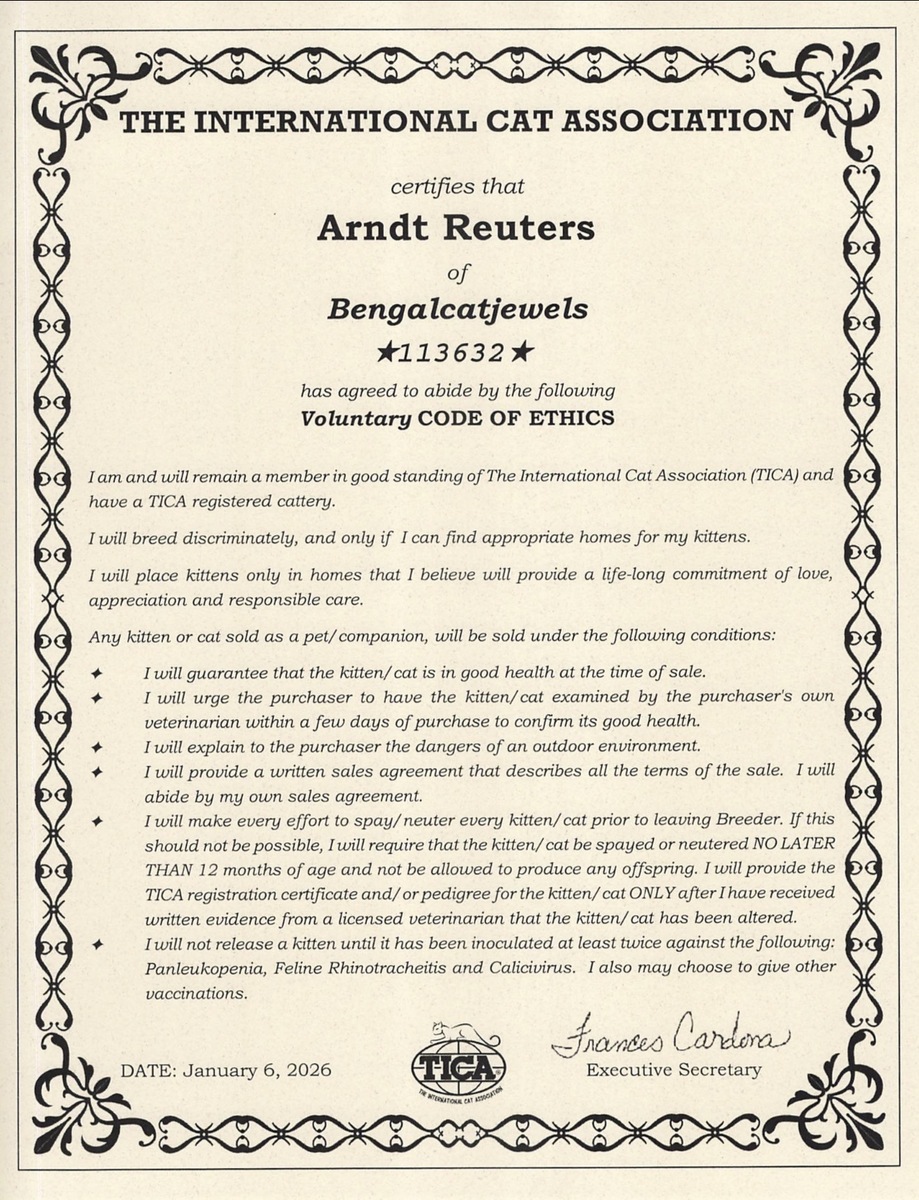
  5. Pedigree (e.g. TICA) and a purchase contract including health information
  6. Open, patient answers to your questions

How we do it at BengalCatJewels

All our breeding cats are DNA-tested for PRA-b, PK-Def and PKD and tested for FeLV/FIV. For HCM, we have them checked regularly by echocardiography. You can find the results for each cat on our Kings and Queens pages under “View DNA test”.

Frequently asked questions

Is a carrier ill?

No. A carrier has one healthy and one altered gene copy and is completely healthy itself. It just shouldn't be paired with another carrier.

Is it OK to breed with carriers?

Yes, if the partner is clear. Then no kitten becomes ill. This preserves valuable lines and genetic diversity – what matters is targeted testing and planning.

Do I need to have my kitten tested myself?

If both parents are clear for PK-Def and PRA-b, the kitten cannot have these diseases. For HCM: regular check-ups at the vet – and an echocardiogram if a heart murmur or other abnormality is found.

How do I recognise HCM in my cat?

Often not at all for a long time. Warning signs are fast breathing at rest (more than about 30 breaths per minute while sleeping), open-mouth breathing or sudden paralysis of the hind legs. The latter is an emergency – go to the vet immediately.

This guide does not replace veterinary advice.

A kitten from BengalCatJewels

Health starts with the choice of breeding cats. We are happy to show you all results and answer your questions – before and after the kitten moves in.

→ See our current kittens
→ Reserve a kitten

More in our guide: Bengal biting during play? · Bengal peeing outside the litter box? · Silver Bengal

Author: Anke, BengalCatJewels – Health & Welfare Specialist, graduate nursing educator (Dipl.-Pflegepädagogin), senior teacher and anaesthesia & intensive care nurse

BengalCatJewels - Exklusive Bengalkatzen aus internationalen Spitzenlinien. BengalCatJewels steht für Premium-Zucht, Gentests, Stammbäume und gesunde Bengal Kitten.
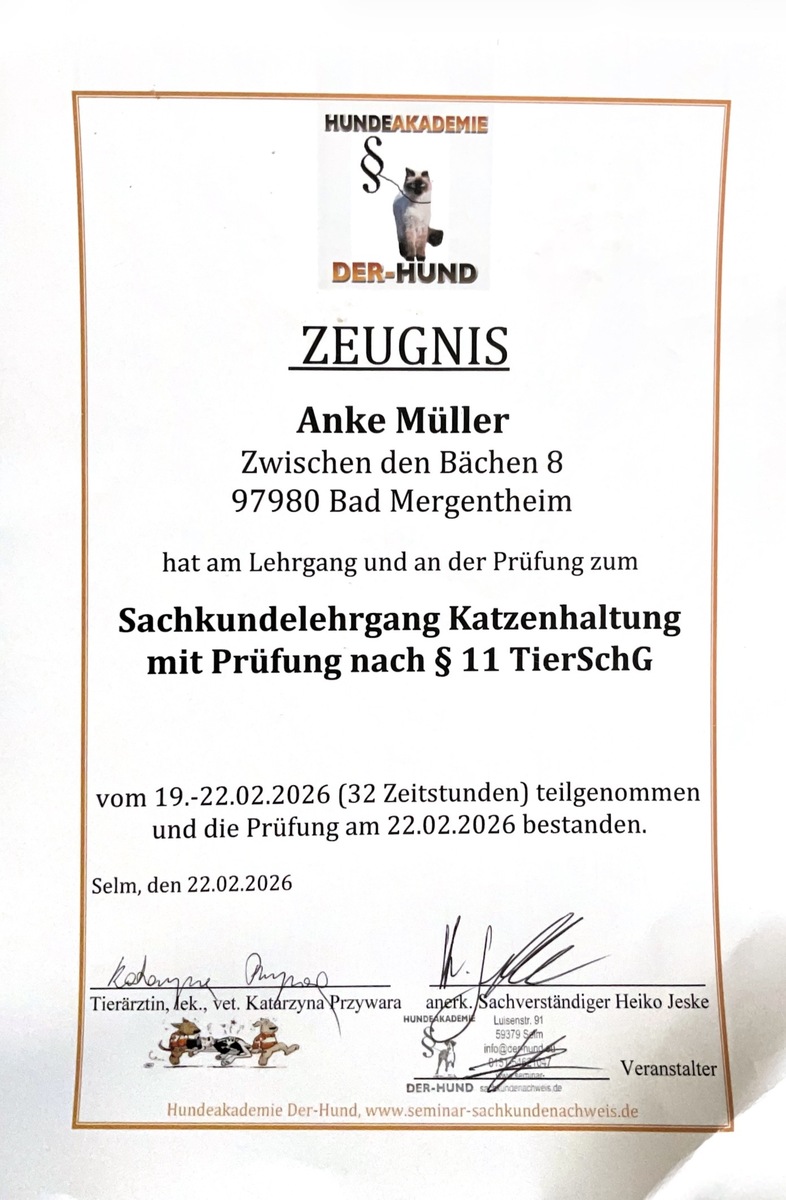
Sachkundenachweis Katzenhaltung nach §11 TierSchG

Erfolgreich abgeschlossener Sachkundelehrgang mit Prüfung nach §11 TierSchG für verantwortungsvolle Katzenhaltung und Zucht.

BengalCatJewels - Exklusive Bengalkatzen aus internationalen Spitzenlinien. BengalCatJewels steht für Premium-Zucht, Gentests, Stammbäume und gesunde Bengal Kitten.
Alles für die Zuchtkatze: Trächtigkeit & Geburt

Weiterbildung zu Einflussfaktoren rund um Trächtigkeit, Geburt und gesunde Entwicklung von Zuchtkatzen.

BengalCatJewels - Exklusive Bengalkatzen aus internationalen Spitzenlinien. BengalCatJewels steht für Premium-Zucht, Gentests, Stammbäume und gesunde Bengal Kitten.
Gute Gene, gesunder Wurf

Seminar zu Partnerwahl, Genetik und verantwortungsvoller Wurfplanung in der modernen Katzenzucht.

BengalCatJewels - Exklusive Bengalkatzen aus internationalen Spitzenlinien. BengalCatJewels steht für Premium-Zucht, Gentests, Stammbäume und gesunde Bengal Kitten.
Nachwuchs in Sicht: Basiswissen Katzengeburt

Grundlagenwissen rund um Trächtigkeit, Geburt und Betreuung von Katzenwürfen.

BengalCatJewels - Exklusive Bengalkatzen aus internationalen Spitzenlinien. BengalCatJewels steht für Premium-Zucht, Gentests, Stammbäume und gesunde Bengal Kitten.
Expertenwissen Katzengeburt

Vertiefte Weiterbildung zu möglichen Komplikationen und professioneller Geburtsbegleitung bei Katzen.

BengalCatJewels - Exklusive Bengalkatzen aus internationalen Spitzenlinien. BengalCatJewels steht für Premium-Zucht, Gentests, Stammbäume und gesunde Bengal Kitten.
Schwierige erste Lebenswochen bei Katzen

Fachseminar zur Betreuung und Gesundheitsvorsorge von Katzenwelpen in sensiblen Entwicklungsphasen.

BengalCatJewels - Exklusive Bengalkatzen aus internationalen Spitzenlinien. BengalCatJewels steht für Premium-Zucht, Gentests, Stammbäume und gesunde Bengal Kitten.
Verantwortungsvolle Zucht & Tierwohl

Weiterbildung zu rechtlichen Grundlagen, Ethik und verantwortungsvoller Tierhaltung in der Zucht.

Ready for Your Bengal Kitten?

Exclusive Bengal Cats from International Top Lines

Exceptional Bengals from selectively bred international lines united by genetic quality, spectacular wild markings, and elegant character.

WhatsApp